Lorem ipsum dolor sit amet

Lorem ipsum dolor sit amet, consectetur adipiscing elit, sed do eiusmod tempor incididunt ut labore et dolore magna aliqua. Adipiscing at in tellus integer feugiat scelerisque varius morbi enim. Eu turpis egestas pretium aenean pharetra magna ac. Feugiat vivamus at augue eget arcu dictum varius duis at. Senectus et netus et malesuada fames ac turpis. Odio facilisis mauris sit amet massa vitae tortor condimentum lacinia. Id semper risus in hendrerit gravida rutrum. Lacus laoreet non curabitur gravida arcu ac tortor dignissim. Tristique sollicitudin nibh sit amet commodo nulla. Mauris augue neque gravida in fermentum et sollicitudin.

Dignissim diam quis enim lobortis scelerisque. Phasellus vestibulum lorem sed risus ultricies tristique nulla. Euismod lacinia at quis risus. Mollis aliquam ut porttitor leo a diam sollicitudin. Morbi enim nunc faucibus a pellentesque sit amet porttitor eget. Purus in mollis nunc sed id semper risus in hendrerit. Etiam tempor orci eu lobortis. Augue interdum velit euismod in pellentesque massa placerat duis ultricies. Tortor id aliquet lectus proin nibh nisl condimentum id venenatis. Vitae tempus quam pellentesque nec nam aliquam sem et tortor. Mattis enim ut tellus elementum sagittis vitae et leo. Massa tempor nec feugiat nisl. Ullamcorper a lacus vestibulum sed. In nibh mauris cursus mattis molestie a iaculis. Lacus sed viverra tellus in hac. Sit amet venenatis urna cursus. Magna eget est lorem ipsum dolor sit amet consectetur adipiscing. Pellentesque habitant morbi tristique senectus et netus.

Consequat interdum varius sit amet mattis vulputate enim nulla aliquet. Urna nunc id cursus metus aliquam eleifend mi in nulla. Elit pellentesque habitant morbi tristique senectus. Ultrices eros in cursus turpis massa tincidunt dui ut. Montes nascetur ridiculus mus mauris vitae ultricies leo. Massa enim nec dui nunc mattis enim. Sed vulputate mi sit amet mauris commodo. Cursus eget nunc scelerisque viverra. Purus sit amet volutpat consequat mauris nunc. Urna nec tincidunt praesent semper feugiat nibh sed. Vehicula ipsum a arcu cursus vitae congue mauris. Dolor sit amet consectetur adipiscing elit pellentesque habitant morbi tristique.

Dolor sit amet consectetur adipiscing elit pellentesque habitant. Interdum varius sit amet mattis vulputate enim. Tempor orci eu lobortis elementum nibh tellus. Molestie nunc non blandit massa enim nec dui. Nulla malesuada pellentesque elit eget. Aliquet enim tortor at auctor urna nunc id cursus. Interdum consectetur libero id faucibus nisl tincidunt eget nullam non. Congue quisque egestas diam in arcu cursus euismod quis viverra. Pellentesque elit ullamcorper dignissim cras tincidunt lobortis feugiat vivamus. Quam viverra orci sagittis eu volutpat odio.

Malesuada nunc vel risus commodo viverra. Amet mattis vulputate enim nulla aliquet. Mauris pellentesque pulvinar pellentesque habitant morbi tristique. Tempus quam pellentesque nec nam aliquam sem. Aliquam id diam maecenas ultricies mi eget mauris pharetra et. Quis lectus nulla at volutpat diam ut. Suspendisse sed nisi lacus sed viverra tellus in. Integer eget aliquet nibh praesent tristique magna sit amet purus. Mi bibendum neque egestas congue quisque egestas diam in arcu. Lacus vestibulum sed arcu non odio euismod lacinia.

Accept
API: terms of use

By downloading content from the portal, the user undertakes to use it exclusively for non-commercial purposes and only for individual use, for professional and scientific purposes, while complying with all copyrights, other proprietary rights, and any stated limitation of rights.

Therefore, content from the portal may not be further copied, reproduced, or otherwise distributed without an express consent of the Ministry of Culture and Media.

Any use of the downloaded content must be accompanied by the note “Copyright (c) 2021, Ministry of Culture and Media of the Republic of Croatia, all rights reserved”.

Accept
Search portal

Tourism and culture

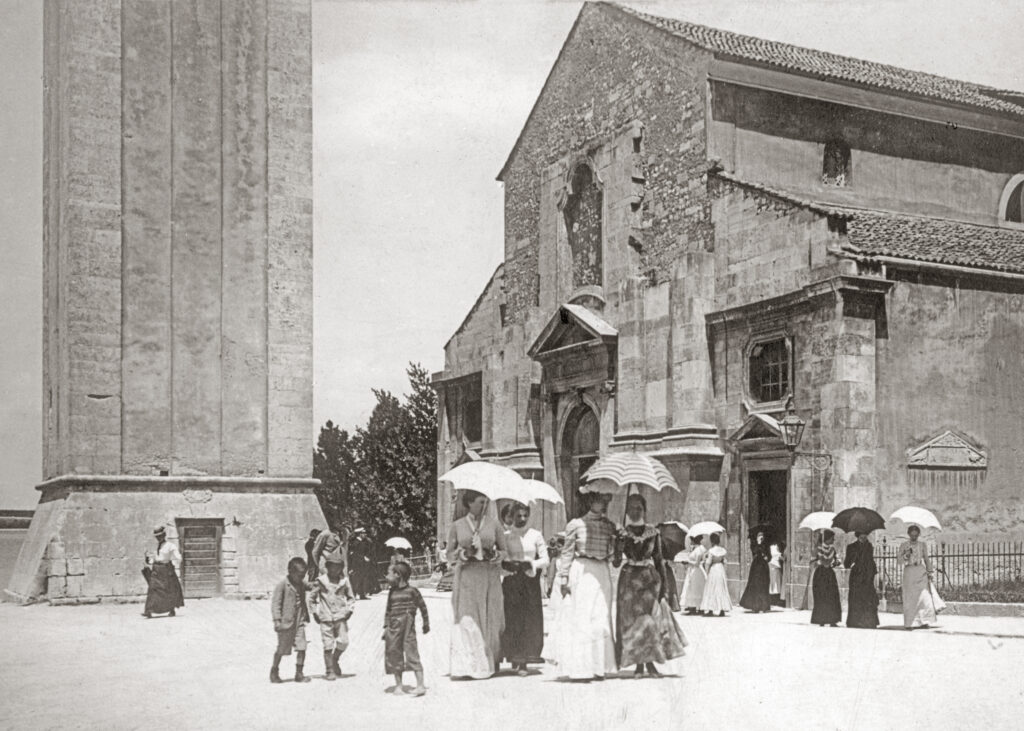
PULA
(Southern part of the Istrian peninsula)
Liveliness and comfort, despite the sun, in the meeting of two worlds in front of the Cathedral of the Assumption of the Blessed Virgin Mary
Until the middle of the 19th century, Pula was a small fishing town with a little more than a thousand inhabitants, and with numerous life problems, since 1848, when Emperor Franjo Josip supported the transformation of the city into the central war port of the Empire, i.e. Zentrakriegshafen it began its development towards a modern metropolis, at the same time the demographic, spiritual, economic and social center of Istria. In the following decades, the city acquired an Arsenal and a Navy, and began to attract an increasing number of people from the entire former Austro-Hungarian Monarchy. Let’s add that the first electric tram in our area was driving through its streets. It was in 1904, four years later the Opatija electric tram, and six years later the Zagreb electric tram. Close to Pula is the magical Brijuni archipelago, which in the first decade of the 20th century became an elite tourist center and a meeting place for prominent and wealthy individuals of the Empire. The result of all of the above is the fact that at the beginning of the 20th century, Pula reached almost 40,000 inhabitants!

Alois Beer, 1912.

Ministry of Culture and Media of the Republic of Croatia
Photo archive of the Conservation Department in Rijeka
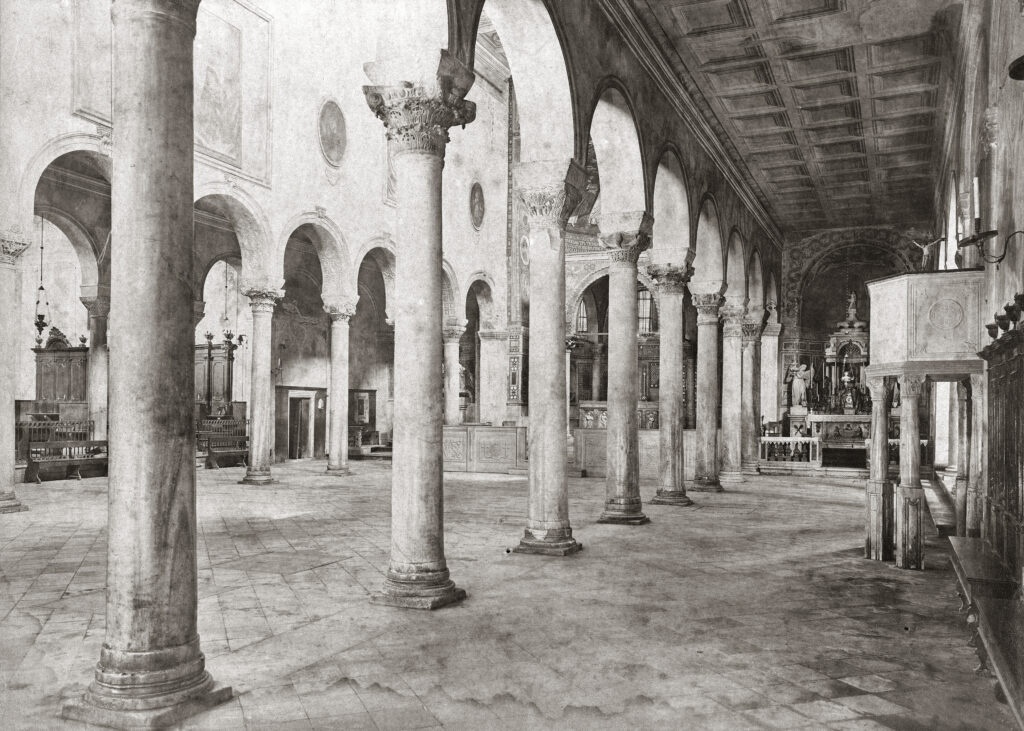
POREČ
The Euphrasian Basilica is one of the most beautiful preserved monuments of early Byzantine art in the Mediterranean. It was built in the 6th century on the site of an early Christian church during the reign of Emperor Justinian I and under Bishop Euphrasius, after whom it is named, and is part of the episcopal complex.
Over the centuries, the Euphrasian Basilica—also the cathedral dedicated to the Assumption of Mary—suffered damage from earthquakes, wars, and fires, leading to a series of modifications in which each era added its own contributions to the original early Christian structure. Today, what we witness is the third church, built in the Gothic style. Despite the passage of time, fragments of 3rd-century mosaics have survived, as well as authentic 5th-century floor mosaics, which, due to their delicate intricacy, represent a prime example of early Christian painting. The radiant mosaics decorating the interior and façade of the church are considered among the most beautiful preserved works of Byzantine art. In 1997, the Euphrasian Basilica was inscribed on the UNESCO World Heritage List.

Giuseppe Greatti (za Alinari), 1910.

Ministry of Culture and Media of the Republic of Croatia
Photo archive of the Conservation Department in Rijeka
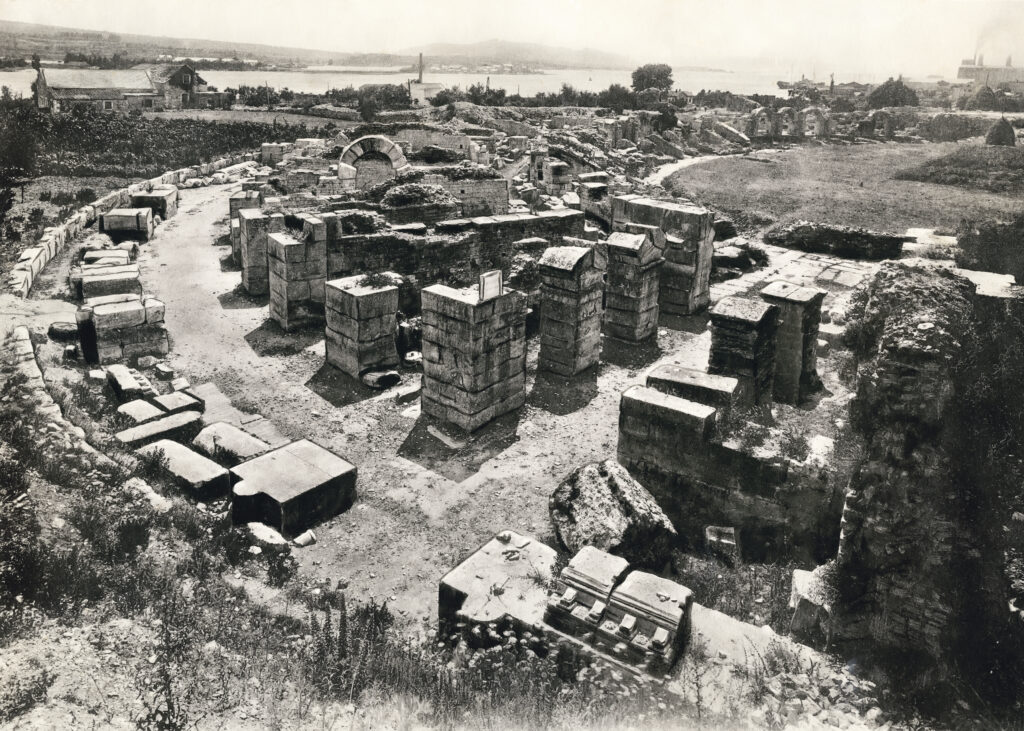
SOLIN / SALONA
Detail of the remains of the ancient Salona
With the suppression of the last rebellion of the indigenous tribe of Illyria, at the very beginning of the 1st century AD, a period of peace and prosperity began for Salona, which is also manifested through urban development and strong construction activity. The photo shows the northeastern part of the Roman amphitheater. The amphitheater was built in the second half of the 2nd century and could accommodate 19,000 spectators, mostly followers of the bloody fights between gladiators and beasts. During the migration of the people, Salona was abandoned, but east of its ruins in the 7th century, the Croatian medieval city of Solin began to prosper. The Kaštela coast can be seen in the background.

Ćiril Metod Iveković, beginning of the 20th century (from the Dyggva photo archive)

Ministry of Culture and Media of the Republic of Croatia
Photo archive of the Conservation Department in Split
Inv. no. 20/115
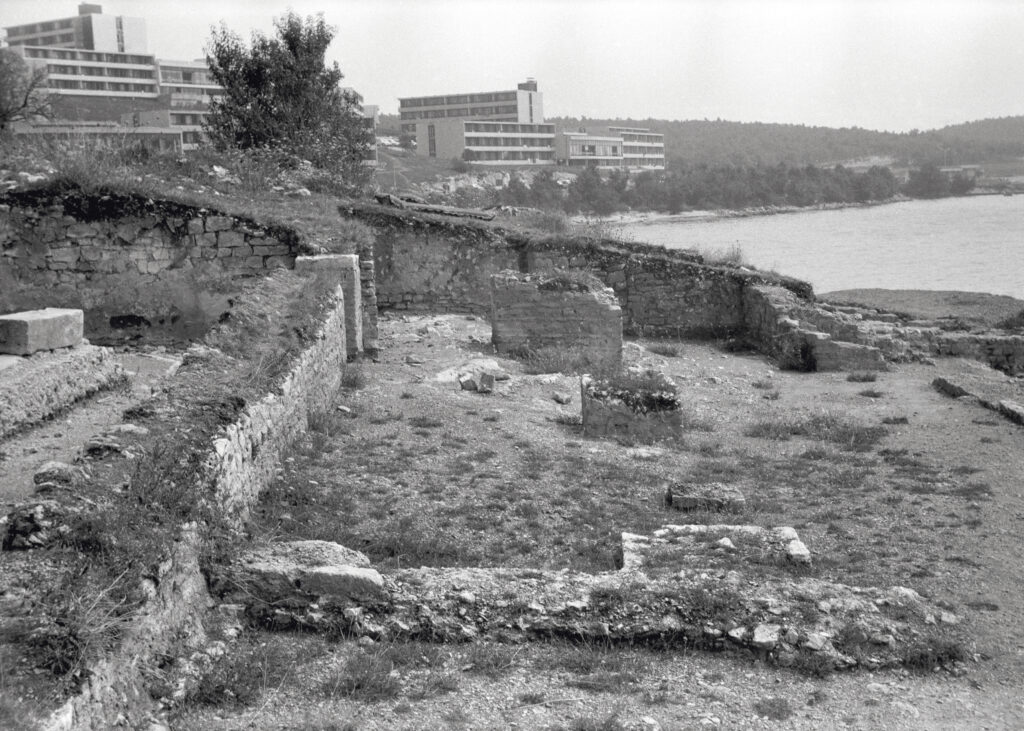
POREČ (west coast of Istria)
The coexistence of historical and contemporary forms of economic activity: a view from the grounds of the former villa rustica to the modern Zelena laguna hotel complex in the final phase of construction
Villa rustica was a common form of settlement and economy outside the city area in Romanized environments during the Roman Republic and the Roman Empire. Functionally, it represented a rural household in the true sense of the word, where the focus was on agriculture, so servants and slaves lived in it. The villa rustica complex used to be a hospital and even a prison. The opposite of the villa rustica was the villa urbana, which represented a particularly well-positioned temporary and idyllic country estate of the privileged classes.
If we ignore Brijuni and the mainland overseas neighbor Pula, the claim is that Istria, referring to its western coast, did not, like Opatija, have a tradition of hotel management. Therefore, from the second half of the 20th century, it turned to the development of mass tourism, which included the accelerated construction of large hotel capacities and offers based on sports, recreation, leisure and entertainment.

Vinko Malinarić, 1967.

Ministry of Culture and Media of the Republic of Croatia
Photo archive of the Conservation Department in Rijeka
Inv. No. 22217, neg. I-10898
DUBROVNIK
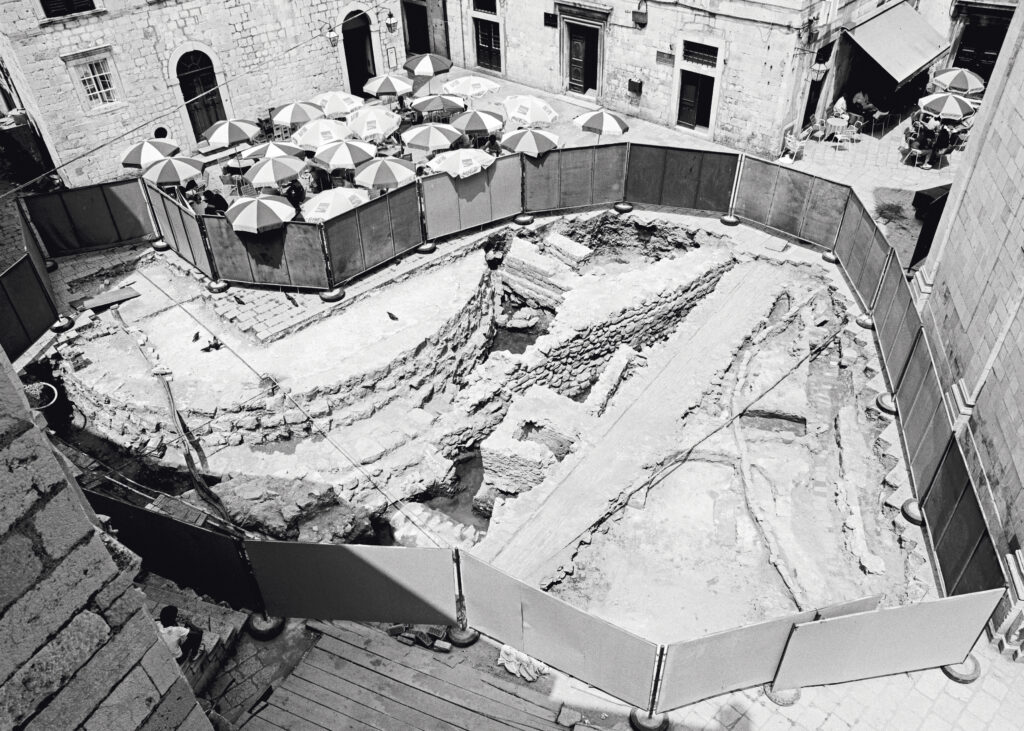
Coexistence of tourism and hospitality with culture and archaeological research
Bunićeva poljana, or as it is called in the regiment, Pujiška placa, is best known to many precisely because of the large number of cafes located there. But have you ever wondered what lies beneath, that is, what the archaeological excavations brought forth. So, archaeological excavations will confirm that the oldest, early medieval core of the city was located in this area in the form of a late antique defensive wall which, it is assumed, surrounded the first Dubrovnik cathedral, and when it lost its function, houses began to be built next to it. There is also the circular foundation of the cathedral’s bell tower, the construction of which began in the 14th century, only to stop on the ground floor, existing as such until 1830, when it was demolished. In this area, in front of the cathedral, there was once a four-leaved chapel with a cruciform plan, around which, as well as next to the cathedral, was the old Dubrovnik cemetery. But that may be superfluous to know at the moment when you are enjoying the city drinking your coffee.

Miiljenko Mojaš 1983.

Ministry of Culture and Media of the Republic of Croatia
Photo archive of the Conservation Department in Dubrovnik
Inv. No. 7150-5
BAUČIĆI (Omiš, Central Dalmatia)
Oneum Archeological Zone
The old ancient core of the settlement on the slopes of the Omis Dinara with partially preserved fortification walls, more than two meters wide, which follow the direction of the coast, and the rest of the polygonal tower built of horizontally layered rammed blocks, rises above the sea and the newly built residential part that stretches along the coast.

Unidentified author, 70s of the 20th century

Ministry of Culture and Media of the Republic of Croatia
Photo archive of the Conservation Department in Split
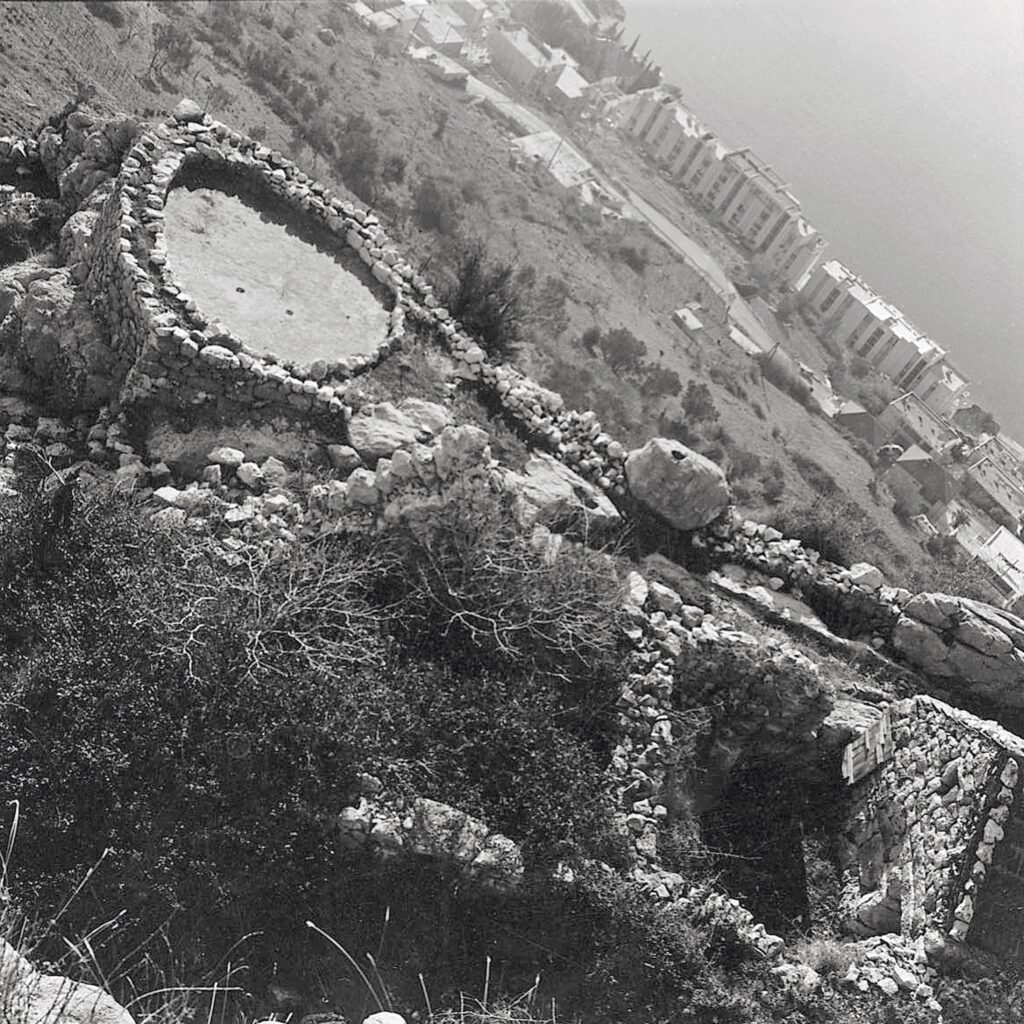
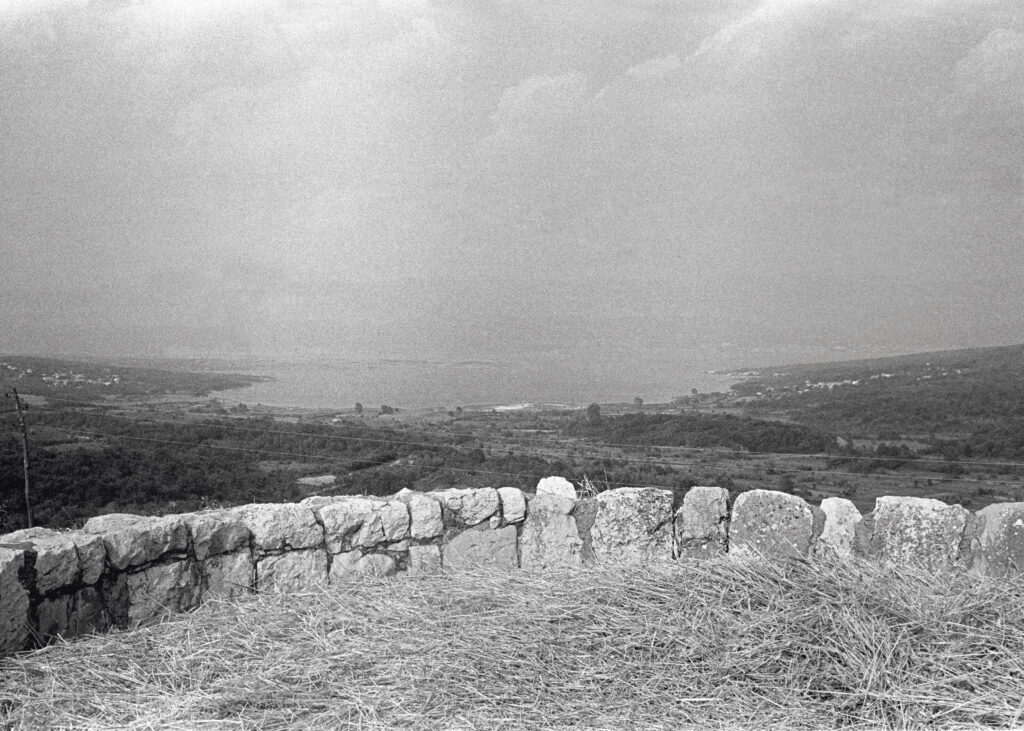
TRIBULJE (Island of Krk)
Threshing floor (largely circular places for threshing grain using treshers for grain or livestock) above Dobrinjska Draga. The coastal settlements of Soline, Čižići, Klimno and Šilo can be seen in the background

Vinko Malinarić, 1971.

Ministry of Culture and Media of the Republic of Croatia
Photo archive of the Conservation Department in Rijeka
Inv. No. 45443, neg. I-22611
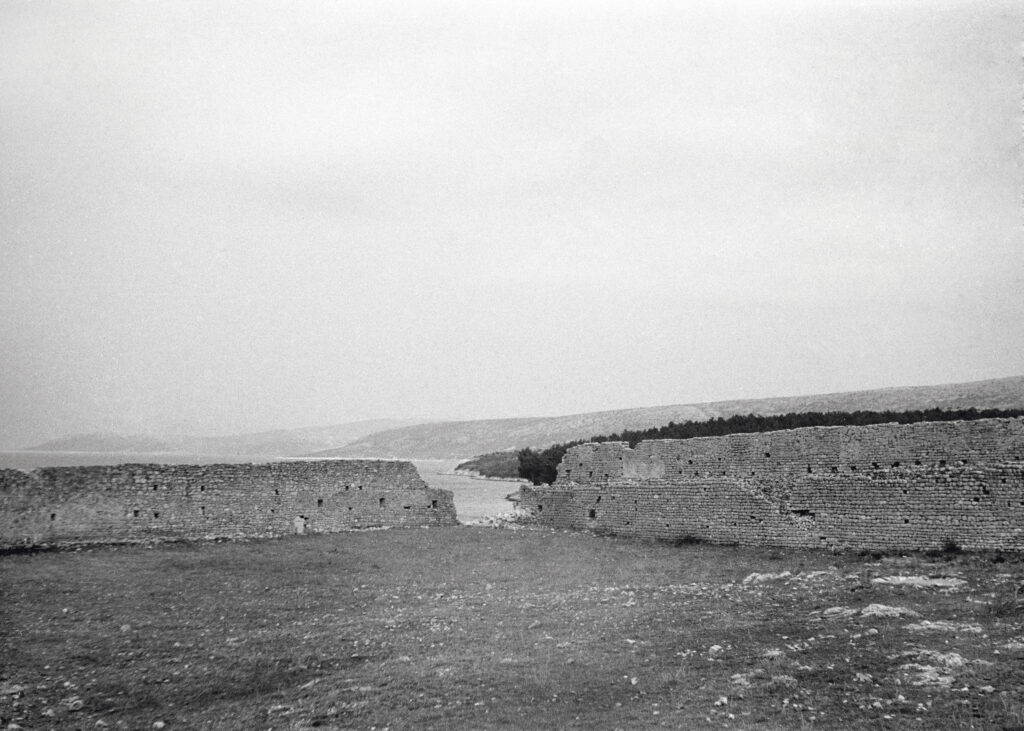
OSOR (island of Cres)
The defensive walls of the city, of which those on the left belong to the ancient period, and those on the right to the Venetian administration of the 16th century

The new Venetian defensive walls of Osor greatly influenced the future urban planning and construction of the city, since they cut the city in half with their spatial orientation and radically reduced its area. On that occasion, the eastern malarial half of the settlement with the early Christian cathedral complex remained outside the boundaries of the new city, which focused on the western part, the strategically and economically much more important part. Then, on the foundations of the ancient tradition, the main town square was built on its territory, of course on the site of the former ancient forum, but also the new cathedral, the construction of which is considered one of the largest significant construction projects of that time in a wider area, without a possible comparison in the construction of the eastern coast of the Adriatic.

Srećko Ulrih, 1962.

Ministry of Culture and Media of the Republic of Croatia
Photo archive of the Conservation Department in Rijeka
Inv. No. 14449, Neg. I-7137
OPATIJA
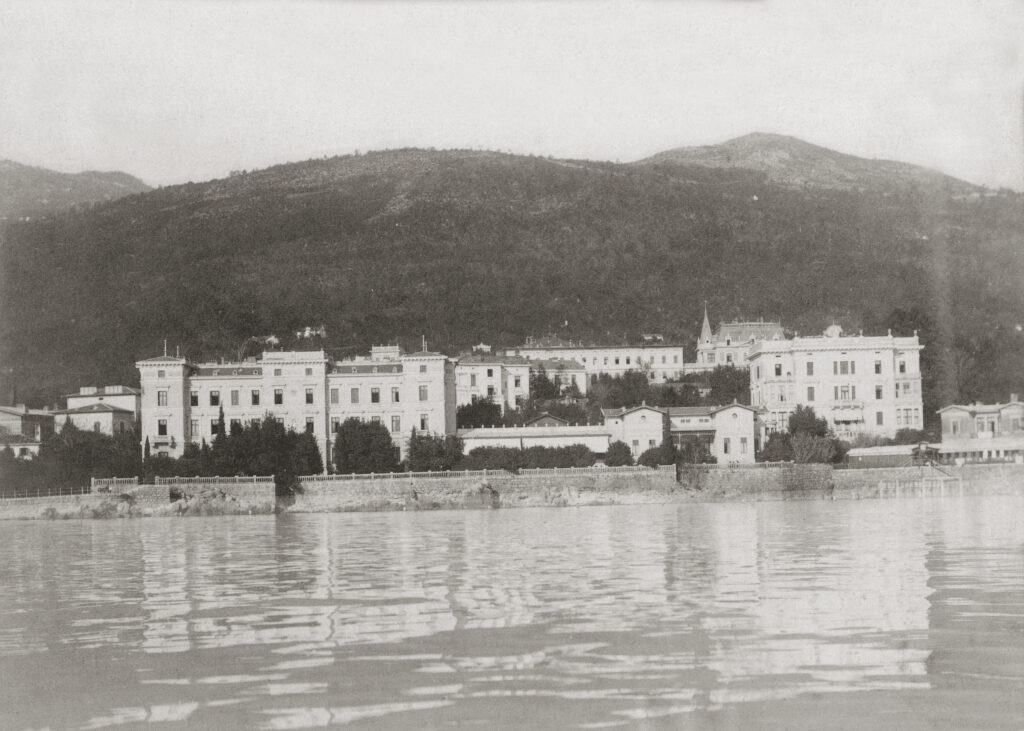
Hotel Kvarner and Villa Amalia, view from the sea
Four decades afzter the construction of the Villa Angiolina , in 1884 Opatija got its first hotel – the Quarnero, the oldest hotel on the Adriatic, which was built in an impressive ten months thanks to the capital of the Southern Reilways. In the
first decades, the hotel business was aimed at the well-known and wealthy, but often sickly, clientele of the Austro-Hungarian Monarchy, who come to Opatija mostly in winter to escape from the cold and gloomy continent in search of sun, seaair, rest and inspiration. Throughout history, many famous names have stayed in Opatija, its Hotel Quarnero and Villa Amalia (the Kvarner annexe built 1890), promoting Opatija’s tourism and culture. These include Isidora Duncan, Jan Kubelik, Amtom Chekhov, James Joyce, Salvatore Quasimodo, Lajos Zilahy, Antun Gustav Matoš, Ksaver Šandor Gjalski, Silvije Strahimir Kranjčević, Vladimir Nazor, Miroslav Krleža, Gabriele D’Annunzio, Stjepan Radić, Lenin, Tito and many others.

Benedikt Lergetporer, 1891.

Ministry of Culture and Media of the Republic of Croatia
Photo archive of the Conservation Department in Rijeka